How to Get Rid of Aphids on Plants
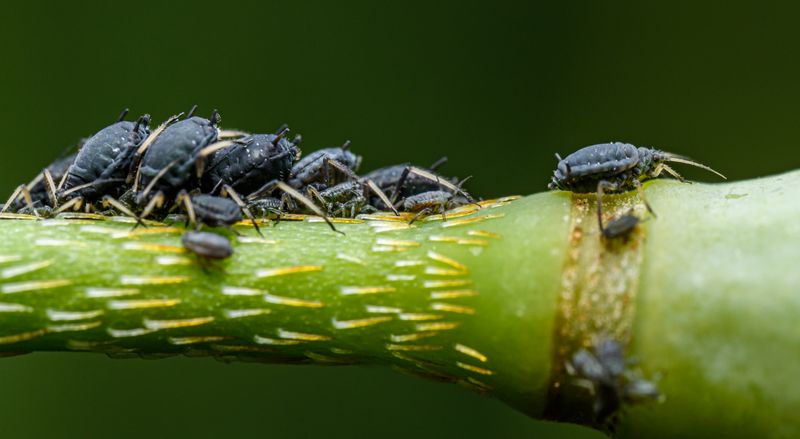
Aphids are among the most common garden pests in North America — small, soft-bodied insects that cluster on new growth, stems, and leaf undersides, piercing plant tissue to feed on sap. They reproduce explosively: a single aphid can produce 80 offspring in a week under warm conditions. Left unchecked, aphid colonies cause stunted growth, distorted leaves, sooty mold from their honeydew secretions, and in severe cases, plant death.
The good news is that aphids are one of the easier garden pests to control — especially with early intervention.
Identifying Aphids
Size: 1/16 to 1/8 inch — visible but small. Often appear as clusters of moving dots on plant stems.
Color: Varies by species — green, yellow, black, white (woolly aphids), pink, or brown. The green peach aphid and black bean aphid are two of the most common in home gardens.
Key features:
- Pear-shaped body with two small tube-like structures (cornicles) at the rear
- Soft body, unlike hard-shelled insects
- Often found on new growth, stem tips, and leaf undersides
- Frequently tended by ants, which protect aphids and harvest their honeydew
Signs of aphid damage:
- Curled, distorted, or yellowed leaves (particularly new growth)
- Sticky honeydew residue on leaves or surfaces under plants
- Black sooty mold growing on honeydew
- Ants swarming on plant stems (a strong indicator of aphid presence below)
- Stunted plant growth or misshapen buds
Control Method 1: Water Spray (Simplest and Free)
For light to moderate infestations, a strong stream of water from a garden hose is surprisingly effective.
Technique:
- Use a jet nozzle or thumb over the hose end to create strong pressure
- Direct the stream at stem tips, leaf undersides, and crevices where aphids cluster
- Repeat every 2–3 days for 2 weeks
Aphids that are knocked off plants typically cannot climb back up and die. This works best on sturdy plants — avoid on delicate seedlings or soft-stemmed plants that could be damaged by pressure.
Control Method 2: Insecticidal Soap
Effectiveness: High for contact kill; no residual Best for: Organic gardens; targeted spray on infested plants
Insecticidal soap (potassium salts of fatty acids) penetrates the aphid’s soft exoskeleton and destroys cell membranes, killing on contact. It has no residual effect, meaning it only kills aphids that are directly hit — so thorough coverage of leaf undersides is essential.
Application:
- Spray directly on aphid colonies, covering all surfaces (top and underside of leaves, stems)
- Apply in the early morning or evening — avoid midday heat, which increases phytotoxicity risk
- Reapply every 4–7 days for 2–3 applications
Products:
- Safer Brand Insect Killing Soap — ready-to-use or concentrate; OMRI-listed for organic use
- Bonide All Seasons Horticultural Oil — kills aphid eggs; useful late season to reduce next year’s population
- Castile soap DIY mix: 2 teaspoons of pure castile soap (Dr. Bronner’s) per quart of water — works but can cause leaf burn on some plants; test on a small area first
Limitations: Does not protect from re-infestation. Phytotoxic to some plants — test before broad application.
Control Method 3: Neem Oil
Effectiveness: Moderate to high; works as both contact kill and antifeedant Best for: Repeated treatments throughout the growing season; organic preference
Neem oil’s active compound (azadirachtin) disrupts aphid feeding and reproduction. Unlike insecticidal soap, neem oil also has some residual effect and is effective against soft-bodied aphid nymphs.
Application:
- Mix 1–2 oz neem oil per gallon of water with a few drops of dish soap (as emulsifier)
- Spray all plant surfaces thoroughly, including stem undersides and leaf backs
- Apply in the evening to reduce phytotoxicity and protect pollinators
- Repeat every 7–10 days and after rain
Products:
- Bonide Neem Oil Ready-to-Use — convenient for small gardens
- Garden Safe Neem Oil Extract Concentrate — better value for larger applications; 3-in-1 (insecticide, fungicide, miticide)
- Harris Neem Oil — cold-pressed; high azadirachtin content
Bonus: Neem oil also suppresses powdery mildew and other fungal diseases — useful as a multi-threat spray during the growing season.
Control Method 4: Beneficial Insects (Biological Control)
Aphids have numerous natural enemies. Encouraging or introducing these predators is the most sustainable long-term control strategy.
Ladybugs (Lady Beetles)
Ladybugs are the iconic aphid predator — a single adult can eat 50–60 aphids per day; larvae eat even more. Ladybug kits (500 to 1,500 live ladybugs) are sold online and in garden centers.
Tips for release:
- Release in the evening after watering the plants — ladybugs need moisture and are less likely to fly off in cooler temperatures
- Release near aphid colonies for immediate impact
- Don’t expect all of them to stay — wild ladybug releases often result in dispersal. Local, garden-caught ladybugs are more likely to stay in your garden.
Attracting wild ladybugs: Plant dill, fennel, marigolds, and yarrow — these provide nectar that adult ladybugs feed on between prey insects.
Green Lacewings
Green lacewing larvae (aphid lions) are among the most aggressive aphid predators. They’re commercially available as eggs, larvae, or adults.
- NaturesGoodGuys Green Lacewing Eggs — one of the most effective releases for garden aphid control
- Price: $10–$30 for 1,000–5,000 eggs
Lacewing larvae are indiscriminate predators — they’ll attack aphids, thrips, whiteflies, and other soft-bodied pests.
Parasitic Wasps
Several species of parasitic wasps (Aphidius colemani, Aphidius ervi) lay eggs inside aphids. The resulting “mummified” aphids turn bronze or gray — a sign biological control is working. These wasps are commercially available and are widely used in greenhouse IPM programs.
Natural Enemies to Protect
Avoid broad-spectrum pesticide sprays that kill beneficial insects. Pyrethroid sprays, in particular, are highly toxic to ladybugs, lacewings, and parasitic wasps — and may set back biological control more than the aphids themselves.
Control Method 5: Companion Planting
Strategic planting can reduce aphid pressure by attracting natural enemies and, in some cases, repelling aphids.
Plants that attract aphid predators:
- Dill and fennel — attract lacewings and parasitic wasps
- Yarrow — ladybug habitat
- Marigolds — beneficial insect habitat; some evidence of aphid-repelling volatile compounds
- Sweet alyssum — particularly attractive to hoverflies (whose larvae eat aphids)
Plants reputed to repel aphids:
- Catnip — contains nepetalactone, a volatile compound
- Garlic — planted near roses (known to be heavily aphid-infested)
- Chives — anecdotally repellent; used around roses and ornamentals
Trap crops: Some gardeners plant nasturtiums near vegetable gardens to attract aphids away from valued crops. Aphid-infested nasturtiums can then be removed or sprayed without affecting food crops.
Control Method 6: Systemic Insecticides (Last Resort)
For severe infestations on valuable plants where contact methods aren’t working, systemic insecticides that are taken up through the roots or trunk of the plant can provide longer-lasting control.
Imidacloprid (Bayer Tree & Shrub Insect Control): A neonicotinoid taken up through roots. Highly effective against aphids but also known to affect pollinators — do not use on flowering plants or within pollinator flight range. Apply in fall or early spring, not during flowering.
Dinotefuran (Safari): Similar mode of action, faster systemic uptake.
Important warning: Neonicotinoids are highly toxic to bees and other pollinators when expressed in pollen and nectar. Restrict systemic insecticide use to ornamentals that don’t flower (or are past flowering season) and non-food plants. Never apply to blooming plants.
Managing Ants That Protect Aphids
A frequently overlooked aphid control issue: ants tend aphid colonies, collecting honeydew and actively driving off aphid predators. If ants are present, aphid control is significantly harder.
Control ants to improve aphid control:
- Apply a sticky barrier (Tanglefoot) around the base of the plant stem or tree trunk — prevents ants from climbing
- Apply ant bait (TERRO) near aphid-infested plants to reduce the local ant colony
- Eliminate ant access from nearby soil to the plant
Aphid Prevention Strategies
Avoid over-fertilizing with nitrogen. High-nitrogen fertilizer produces lush, soft new growth — exactly what aphids prefer. Use slow-release fertilizers and avoid excess nitrogen, particularly in summer.
Inspect new plants before introducing them to the garden. Nursery plants frequently carry aphid populations. Check stem tips and leaf undersides before planting.
Encourage beneficial insect habitat. A diverse garden with flowering plants for nectar and pollen supports natural aphid predator populations throughout the season.
Reflective mulch: Silver or metallic reflective mulch confuses aphids and reduces landing on crops. Used commercially for cucumbers, peppers, and other aphid-susceptible crops.
Aphid Control by Plant Type
Roses
Roses are heavily targeted by aphids (particularly the rose aphid, Macrosiphum rosae). Early season pressure is highest as new buds and shoots emerge.
Best approach: Water blast weekly; apply neem oil every 7–10 days during high pressure; introduce ladybugs or lacewing larvae for mid-season biological control. Avoid systemic neonicotinoids on roses during bloom.
Vegetables
Best approach: Water blast; insecticidal soap; beneficial insect release. Avoid neonicotinoids entirely on food crops.
Trees and Shrubs
Aphids on trees (woolly apple aphid, woolly beech aphid, spirea aphid) often indicate larger infestations in the canopy. Water blasting is impractical; neem oil or insecticidal soap applied by hose-end sprayer can reach lower branches. Natural predator populations typically bring tree aphid populations into balance — intervention is usually unnecessary unless damage is severe.
When to Be Concerned vs. When to Tolerate
A few aphids on a healthy plant in a garden with natural predators is normal and not cause for treatment. Aphid populations naturally cycle — they build rapidly but are controlled by predators, parasites, and weather. Treating every aphid sighting disrupts this cycle and destroys beneficials.
Treat when:
- The infestation is large and spreading (hundreds of aphids on multiple growth tips)
- Visible plant distortion, wilting, or growth stunting is occurring
- The plant is a valuable specimen with no natural predator control apparent
- Ant tending has suppressed natural control
Tolerate when:
- Only a small cluster on otherwise healthy plant
- You observe ladybug adults or larvae, lacewing larvae, or parasitic wasp mummies already present
- Early season on ornamentals — populations often crash naturally in late spring
Bottom Line
Aphid control starts with regular inspection and early intervention. A strong water spray handles most light infestations. Insecticidal soap and neem oil are the most effective organic options for moderate infestations. For long-term control, attract and protect natural predators — ladybugs, lacewings, and parasitic wasps — through companion planting and by avoiding broad-spectrum pesticides. Reserve systemic insecticides for severe cases on non-flowering plants only, and always eliminate ant tending when it’s protecting an aphid colony.

Kevin Larrabee
Independent trade-focused editorial team