How to get rid of Argentine ants: An IPM control plan
Quick answer
To get rid of Argentine ants, confirm the likely species and trace its routes, remove food and moisture, use a slow-acting bait labeled for the pest and placement site, avoid spraying near bait, and seal entries as activity declines. Large linked colonies can take several weeks to suppress, so monitor bait acceptance and trail activity instead of judging the plan by one day of sightings.
How to control Argentine ants around a home
A monitoring-led plan that combines identification, baiting, sanitation, moisture correction, and exclusion.
1. Confirm and map the activity
Check worker size, color, trails, moisture, and entry points. Photograph specimens and trace routes indoors and outdoors before treating.
2. Remove competing food and water
Clean spills, store food and pet food, empty trash, and repair leaks so the labeled bait competes with fewer resources.
3. Test bait acceptance
Place a small amount or station exactly where the label permits near an active route, inaccessible to children and pets. Do not spray near bait.
4. Maintain the bait
Check consumption and condition, then replenish, replace, or relocate only as the label directs. Allow workers to carry the slow-acting bait back.
5. Reduce outdoor support
Correct excess irrigation, move moist mulch and leaf litter away from the foundation, trim plant bridges, and address aphids or scale with plant-appropriate IPM.
6. Seal and monitor
As traffic declines, seal confirmed entry gaps without blocking required drainage or ventilation. Compare repeat trail counts and escalate if activity does not trend down.
Common questions
- What is the best bait for Argentine ants?
- Use a slow-acting bait whose current label lists the target ant and intended indoor or outdoor site. Argentine ants often accept sweet liquid bait, but food preference can change. Test a labeled option on an active trail, keep it fresh as directed, and never spray around it.
- How long does it take to get rid of Argentine ants?
- Do not expect an overnight result. Extension guidance says bait can take several weeks, and a large linked population may require replenishment, exclusion, moisture correction, and professional follow-up. Compare trail counts over time rather than expecting immediate disappearance.
- Why do Argentine ants keep coming back?
- Argentine ants can occupy many shallow, connected nest sites with multiple queens. Food, water, honeydew-producing insects, mulch, leaks, and unsealed routes can support reinvasion even after visible workers are killed.
Source note: Reviewed September 2026 against UC Statewide IPM guidance, the February 2026 Mississippi State University Extension revision on Argentine and odorous house ants, and current EPA pesticide-label guidance. The product label and local requirements control. The Pexels photo is illustrative, not an identification image.
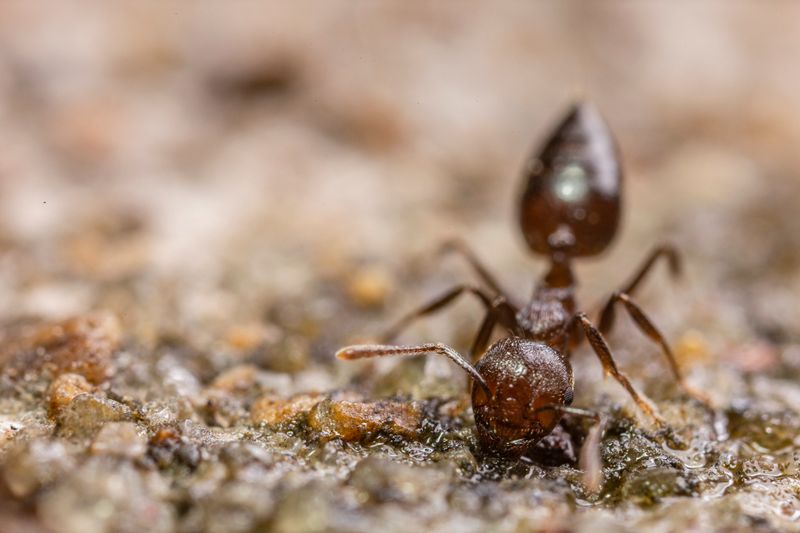
The most reliable way to get rid of Argentine ants is to control the colony, not just the workers on the counter. Confirm the likely species, map the trail, remove competing food and water, and use a slow-acting bait labeled for Argentine ants and the intended site. Keep sprays away from the bait, then combine the treatment with exclusion and outdoor habitat changes.
This is usually a weeks-long integrated pest management (IPM) job. Argentine ants can occupy connected nests with multiple queens, so killing one visible trail may create only a short pause.
First, Make Sure They Are Argentine Ants
Argentine ant workers are small, uniform in size, dull to medium brown, and often travel in distinct, busy trails. UC IPM lists workers at about 1/8 inch long with one node between the thorax and abdomen. Mississippi State University Extension describes the node as upright and notes a stale or musty odor when freshly crushed.
Those clues are not enough for a confident identification in every home. Argentine ants and odorous house ants are easy to confuse without magnification.
| Clue | Argentine ant | Odorous house ant |
|---|---|---|
| Worker appearance | Uniform small brown workers | Small brown to blackish-brown workers |
| Node | One upright, pointed node visible with magnification | One flattened node that can be hard to see from above |
| Odor | Sometimes described as stale or musty | Often described as rotten coconut |
| Typical movement | Strong, defined trails that may connect many outdoor nest sites | Trails indoors and outdoors; may nest in wall voids near moisture |
Treat odor as a supporting clue, not a stand-alone test. A clear photo or intact specimen gives an extension office or pest professional better evidence. If the ants vary greatly in size, sting, build a mound, or leave coarse wood debris, identify them before choosing bait. The general household ant guide covers other situations.
Why Argentine Ant Control Is Different
The colony you are trying to control may not be one neat mound. UC Statewide IPM explains that Argentine ant nests are often shallow and linked into a large supercolony with multiple queens. Nests may shift with heat, drought, heavy rain, or cool weather.
Likely shelter includes moist soil, leaf litter, mulch, boards, potted plants, rotting wood, siding gaps, wall voids, and plumbing leaks. Outdoors, Argentine ants also feed on honeydew from aphids, scales, and mealybugs.
That biology explains two common failures:
- A contact spray kills exposed workers but leaves queens and hidden nests active.
- One treated entry point may be replaced by another route from the same connected population.
An effective plan therefore combines monitoring, sanitation, bait, habitat correction, and exclusion—the same basic sequence used in integrated pest management for homeowners.
A Six-Step Argentine Ant Control Plan
1. Map Trails Before You Treat
Follow active trails in both directions. Indoors, inspect cabinet edges, plumbing gaps, frames, thresholds, baseboards, and pet-feeding areas. Outdoors, check the foundation, irrigation lines, tree trunks, pots, mulch edges, and vegetation touching the building.
Create a baseline: count ants crossing one point for five minutes and take a photo. Repeat at the same time every few days. This is not a population estimate, but it shows whether traffic is trending down or moving.
2. Remove Food and Moisture Competition
Seal sugar, baked goods, fruit, grease, and pet food in ant-resistant containers. Clean residues from container exteriors, empty trash, and limit how long pet bowls remain out. Repair dripping faucets, sweating pipes, irrigation leaks, and wet cabinet materials.
For immediate cleanup away from a bait placement, vacuum workers or wipe the trail with damp, soapy water. This removes ants and trail residue without leaving a persistent pesticide deposit. Once ants are feeding at bait, do not erase or spray the route between them and that bait.
3. Use a Labeled, Slow-Acting Bait
Choose a ready-to-use bait whose current label lists the pest and the exact indoor or outdoor site. Argentine ants often accept sweet liquid bait, but preferences can change with season and colony needs. The ant bait guide by species explains how to compare food base, formulation, placement, and label restrictions without treating a product name as a guarantee.
Place bait near an active trail only where the label permits. Protect outdoor placements from weather and keep all bait away from children, pets, non-target animals, and food-contact surfaces.
The goal is for workers to feed and carry a slow-acting material back to nestmates. UC IPM’s Argentine ant baiting guidance warns that results may not be evident for several weeks and recommends checking bait regularly. Do not use a repellent spray on the trail or around the bait. It can stop workers from feeding and distributing it.
Avoid improvised pesticide recipes. Too strong a mixture can kill workers before they share it; too weak a mixture may fail; and an open homemade container can create avoidable exposure. EPA advises using ready-to-use products when possible and keeping baits away from children and pets in its household pest-control safety guidance.
4. Check Acceptance, Not Just Placement
A bait station on the floor is not proof that the colony is feeding. Look for these signs:
- Workers enter the station or feed at the labeled placement.
- A steady route connects the bait to an entry point.
- The bait stays fresh, available, and free of spray, cleaner, dust, or food contamination.
- Comparable five-minute trail counts begin to decline over repeated checks.
Seeing more ants at an accepted bait at first is normal. If workers ignore it, remove competing food and reconsider the formulation or location within the label directions. Never add another pesticide or exceed the labeled amount.
5. Reduce Outdoor Nest Support
As baiting proceeds, make the building edge less favorable:
- Move leaf litter and excessive organic mulch away from the foundation.
- Correct overwatering and persistent damp spots.
- Trim branches, vines, and shrubs that bridge to the roof or walls.
- Inspect plants on active trails for aphids, scales, or mealybugs and use plant-specific IPM rather than automatically spraying the entire landscape.
- Remove boards, pots, or debris that create protected moist pockets when they can be moved safely.
The February 2026 Mississippi State Extension guide emphasizes multiple methods and patience. Eliminating every Argentine ant outdoors is rarely realistic; aim to reduce pressure and prevent indoor invasion.
6. Seal Confirmed Routes and Keep Monitoring
After you have mapped a route and bait uptake is established, seal accessible cracks around pipes, cables, frames, thresholds, siding, and the foundation as activity declines. Do not block weep holes, drainage paths, combustion-air openings, or required ventilation. The whole-house pest-proofing guide helps separate safe sealing tasks from openings that need a building professional.
Continue consistent trail checks through weather changes. A sudden shift after rain, heat, or irrigation does not automatically mean the bait failed; inspect for a new route, moisture source, or outdoor trail before applying more pesticide.
What Not to Do
- Do not spray visible trails while baiting. Fast knockdown can interfere with colony-level bait transfer.
- Do not judge success overnight. A large connected population can take several weeks to suppress.
- Do not assume any “ant killer” fits the job. Fire-ant mound bait, indoor gel, and outdoor liquid bait can have different pests, sites, and directions on their labels.
- Do not place pesticide where children or pets can reach it. Review the label and the site’s pet-safe pest control planning guide before placement.
- Do not use more than the label allows. EPA explains that the label defines where, how, how much, and how often a pesticide may be used in its introduction to pesticide labels.
When to Call a Pest Control Professional
Get professional help when identification is uncertain, trails cross several rooms or connected units, nests appear to be in inaccessible voids, activity is not trending down after several weeks of correct bait use, or safe placement is not possible.
Ask the provider to document the species evidence, trail and nest map, product and registration details, placement sites, moisture or landscape corrections, follow-up schedule, and completion criteria. A vague promise to “spray the perimeter” does not explain how the colony will be monitored or why the chosen treatment fits the site.
Your Next Step
Photograph an intact worker, draw the indoor-to-outdoor trail, and record a five-minute baseline count before buying or applying anything. Then use the pest ID flowchart to check whether the evidence supports Argentine ants or a lookalike.
If the identification fits, start with sanitation, moisture correction, and a label-compliant bait test. Recheck the same trail points over several weeks, seal confirmed routes as pressure declines, and escalate when the evidence is not improving.
Image: Jimmy Chan via Pexels. Illustrative ant photo; do not use it to identify a species.

Kevin Larrabee
Independent trade-focused editorial team