Mouse vs. Rat Droppings: Identification and Safe Cleanup
Quick answer
Mouse droppings are generally smaller and pointed, while rat droppings are larger and often blunter. Shape and size overlap, so use location, tracks, gnawing, entry gaps, and captured specimens before choosing mouse- or rat-sized control equipment.
Common questions
- Can I vacuum mouse or rat droppings?
- No. CDC guidance says not to sweep or vacuum dry rodent urine, droppings, or nesting material because that can put contaminated particles into the air.
- Can a photo confirm whether droppings came from a mouse or rat?
- Usually not. Scale, age, moisture, camera angle, juvenile rats, and other pests can make a photo misleading. Combine the droppings with location and other evidence.
Source note: Reviewed July 2026 against current CDC rodent-cleanup guidance and university extension identification resources; a photo cannot establish species or health risk.
Droppings in a cabinet, attic, or garage can confirm that something has been active, but they do not automatically tell you mouse or rat. Size and shape provide useful clues; location, tracks, gnawing, entry points, and trapping results make the conclusion stronger.
Start with safety. Do not touch, sweep, or vacuum dry droppings. The CDC rodent cleanup guidance warns that sweeping or vacuuming can put contaminated particles into the air.
Mouse vs. Rat Droppings at a Glance
| Clue | House mouse | Rat |
|---|---|---|
| Typical size | About a grain of rice | About a small raisin; generally much larger |
| Shape | Slender, often pointed at one or both ends | Thicker; often blunt or capsule-shaped, depending on species |
| Common indoor zones | Cabinets, drawers, pantries, wall edges, behind appliances | Garages, crawl spaces, attics, utility rooms, pet-food areas |
| Other evidence | Fine gnaw marks, small tracks, nesting near food | Larger gnawing, wider smudge marks, burrows or elevated travel routes |
Penn State Extension describes mouse droppings as pointed and roughly rice-sized, while rat droppings are blunt and closer to a small raisin. Those are practical field clues, not a guarantee.
Why Size and Shape Have Limits
Droppings change appearance as they dry. Camera perspective can make a small dropping look large, and a photo without a ruler provides poor scale. Juvenile rats can also leave smaller evidence than an adult.
Species differences add another complication. Roof rat and Norway rat droppings do not always have the same outline. Cockroach droppings, bat guano, seeds, and other debris may also be mistaken for rodent evidence.
Use these comparison habits:
- Photograph droppings beside a ruler without moving them.
- Record the room and exact position, such as an upper shelf or floor-wall edge.
- Note whether the pieces are scattered along a runway or concentrated near food.
- Look for footprints, rub marks, gnawing, nesting material, and entry gaps.
- Avoid calling droppings “fresh” based on color alone; lighting and moisture can mislead.
A photograph cannot diagnose the rodent species or the health risk of an exposure.
Location Can Strengthen the Identification
House mice often nest close to food and shelter. Evidence may appear inside drawers, beneath sinks, behind stoves, along baseboards, or in stored boxes. Rats can use the same areas, but their behavior may lead you elsewhere.
Norway rats are commonly associated with lower levels, crawl spaces, foundations, burrows, and ground-level food. Roof rats are capable climbers and may leave evidence in attics, overhead storage, ceiling voids, or along elevated routes. The UC IPM rat guide recommends combining droppings with nests, smudge marks, burrows, gnawing, and travel patterns.
The EPA also lists shredded nesting material, chewed packaging, holes through walls or floors, and stale odors as signs of a rodent infestation.
Safe Cleanup Checklist
For a limited amount of droppings in an ordinary home area, follow the current CDC steps and the disinfectant label:
- Ventilate the space. For homes, sheds, cabins, and similar buildings, CDC advises opening doors and windows for 30 minutes and leaving the area during that period.
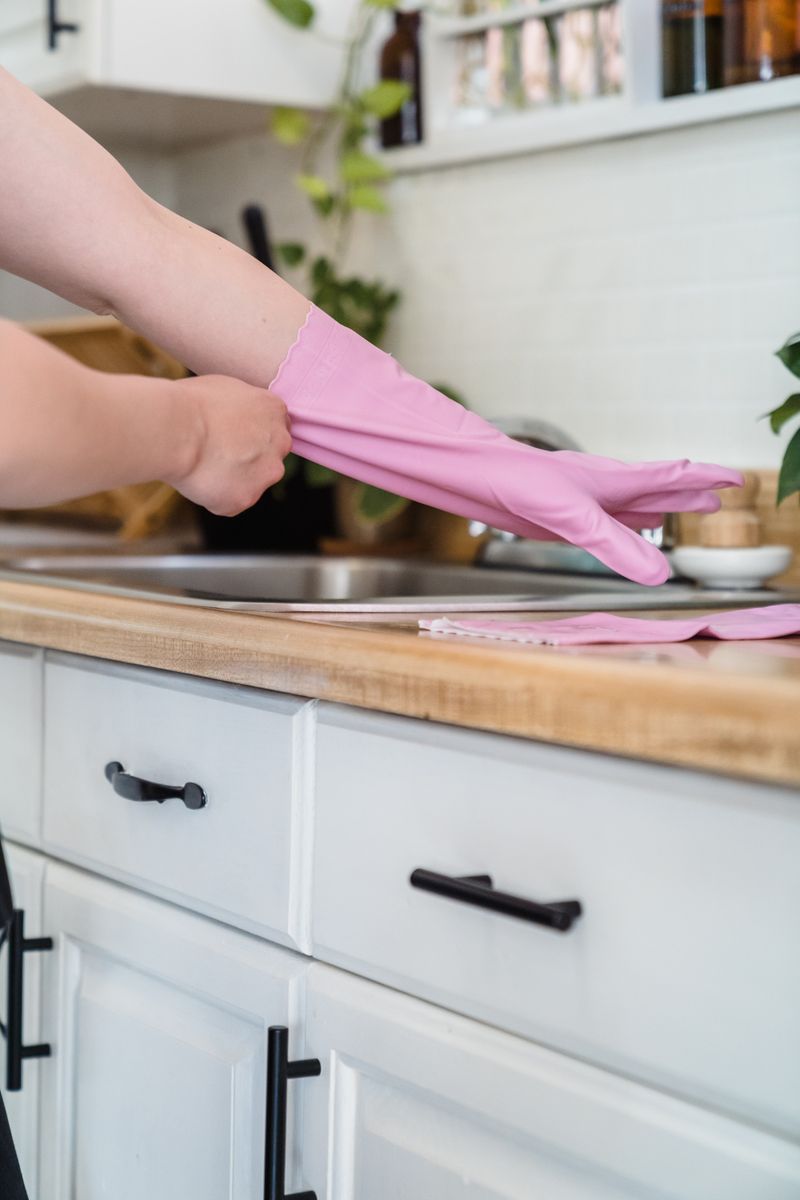
- Put on rubber or plastic gloves. Keep children and pets away from the work area.
- Wet the material thoroughly. Use an EPA-registered disinfectant or a freshly prepared bleach solution as directed by CDC. Never mix bleach with ammonia or other cleaners.
- Allow the required contact time. CDC specifies five minutes for its bleach solution or the time printed on the disinfectant label.
- Wipe up with paper towels. Place waste in a covered garbage container that is emptied regularly.
- Disinfect the surrounding hard surface. Clean floors, counters, cabinets, or drawers as appropriate.
- Wash gloved hands, remove gloves, and wash bare hands. Use soap and warm water.
Do not use a broom, standard vacuum, shop vacuum, or high-pressure air on dry droppings. If you already vacuumed, stop and consult the CDC page for the cleanup steps that apply to the space.
When Cleanup Needs Professional Help
Heavy contamination is not simply a larger version of ordinary cleanup. The CDC calls for special precautions in heavily infested buildings, vacant dwellings with large rodent populations, and structures where rodent-spread disease has been confirmed in the local rodent population.
Professional or agency guidance is especially important when:
- Droppings and nests cover a large part of an attic, crawl space, barn, or vacant building.
- Contaminated insulation must be removed.
- Rodents have entered heating or air-conditioning ducts.
- The area cannot be reached or ventilated safely.
- Work would require respiratory protection; workplace rules may require medical evaluation and fit testing.
- A person feels ill after rodent exposure.
Contact a healthcare provider about illness concerns and explain the rodent exposure. For cleanup requirements, contact the local or state health department or an appropriately trained remediation professional.
Use the Evidence to Choose a Control Plan
Identification changes equipment size and placement. A young rat may not reliably trigger a rat trap, while a mouse-sized trap is not appropriate for an adult rat. Keep a simple evidence log before moving devices.
For likely mice, see our step-by-step mouse control guide. For likely rats, use the rat control guide. Both should be paired with exclusion rather than repeated trapping alone.
Inspect gaps around pipes, cabinets, doors, vents, foundations, eaves, and utilities. The CDC notes that mice can enter through a pencil-width opening, about 1/4 inch. Our home pest-proofing checklist covers common inspection zones, while the rodent exclusion cost guide helps compare professional sealing scopes.
If a pesticide or rodenticide is considered, follow the current product label, allowed site and target pest, federal and state rules, and all child, pet, wildlife, and occupant precautions. Do not place loose bait where people or animals can reach it.
Bottom Line
Mouse droppings are usually smaller and more pointed; rat droppings are generally larger and blunter. Treat those features as clues, not a photo-based diagnosis. Location, gnawing, tracks, travel routes, entry gaps, and a captured specimen provide a more reliable picture.
Whatever the species, avoid dry sweeping or vacuuming. Wet, disinfect, wipe, and escalate heavy or inaccessible contamination to trained help.
Image: Liliana Drew via Pexels.

Kevin Larrabee
Independent trade-focused editorial team